


SOMA / STUDIES
Find a study. Read it closely.
Original human studies, with source links and review limits.

A closer look
at the evidence.
Human cell-therapy research, organized for SOMA. Read the clinical findings, see the limits, and go straight to the original study.
Explore the researchTHE SOMA EVIDENCE NETWORK
Every finding has a source.
Follow the paper, its findings and the limits. Scroll to see how they connect.
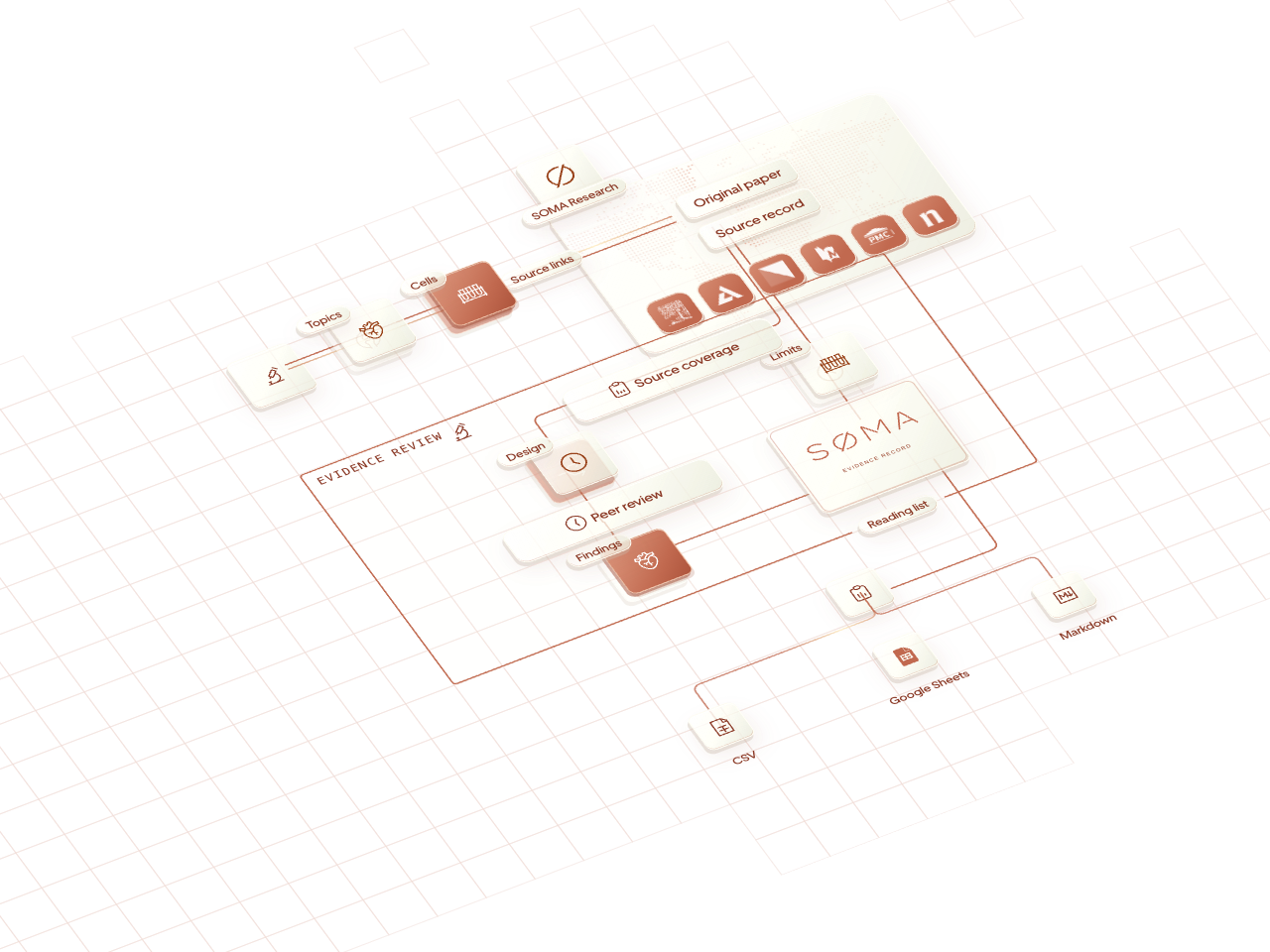
Start with a clear question.
The condition and cell product define what you need to read.
ORIGINAL PAPERS. TRACEABLE SOURCES.
Sources behind the research.


Explore all 12 sources


THREE QUESTIONS TO BRING TO EVERY PAPER
Look beyond the headline.
The cell product, the study design and the clinical endpoint each change what a result can mean.
THE RESEARCH LIBRARY
Read the evidence for yourself.
33 human studies. Original papers, clinical findings and the limits alongside them.
Refine the evidenceCondition, product, design & more
These filters describe the source records, not evidence grades. Individual peer review is documented for 3 papers and unverified for 30; independent replication has not been assessed. Unconfirmed routes remain selectable.
Sorting uses the recorded publication date. Month-only and year-only dates remain approximate; year filters use the record year.
Published is one question.
Validated is another.
This is a purposeful evidence map, not an exhaustive systematic review or a treatment recommendation. Favorable, null and early safety studies are all included.
These are descriptions of the reported primary result or study purpose. They are not evidence grades, pooled success rates or approval status.
01 / Discovery & screening
Grounded Meta Muse Spark searches produced a retained pool of 41 candidate papers. PubMed and Europe PMC identities, dates, journals and condition groups were checked. Thirty distinct original human studies were selected across five areas for Batch 01. On October 11, 2026, Batch 02 added three distinct randomized studies: UC-MSC frailty, laromestrocel in mild Alzheimer’s disease, and locally injected UC-MSCs for knee osteoarthritis. The library now retains 33 studies. Unrelated Muse devices and acronyms were removed; follow-up reports were not counted as new trials.
02 / Read the supporting source
All 33 abstracts and bibliographic records were checked. Key methods and results sections were checked in 19 accessible full texts; 14 entries remain explicitly abstract-only. Full supplements were not comprehensively reviewed. Nineteen ClinicalTrials.gov records were cross-checked for trial identity and primary endpoint/time point; historical registry amendments were not audited. Batch 02 also checked two current registries and the complete frailty correction; the knee study’s original registry was not independently accessed.
03 / Separate clinical findings from inference
Primary clinical results are shown separately from secondary outcomes, subgroups, imaging and within-group changes. Biological plausibility and mechanistic explanations do not establish efficacy. Safety findings retain reported denominators and attribution where available.
04 / Mark review & validation honestly
3 papers explicitly document peer review in the material read. The other 30 are journal publications with individual review unverified; unknown does not mean unreviewed. No preprints were selected in this initial batch. Independent replication, formal result-level risk of bias and GRADE across outcomes were not comprehensively assessed.
05 / Keep unresolved issues visible
MESEMS has two linked corrections whose contents were inaccessible. RESPINE has safety count and attribution discrepancies. The diabetes study S19 has unclear primary denominators. Registry and paper enrollment differences are retained rather than silently reconciled. Batch 02 flags the frailty abstract/Table 3 effect discrepancy and registry mismatch; the Alzheimer study’s secondary endpoint amendment and exploratory comparisons; and the knee study’s within-group/subgroup findings. Publication-day precision is preserved only where supported.
06 / Review ownership & scope
Meta assisted bounded discovery; Codex independently checked the supporting sources and registry records. In Batch 02, one Spark registry-page retrieval failed; Codex checked that registry directly. A completed model response alone was not accepted as verification. This is AI-assisted review, not two independent human reviewers. Retraction surveillance beyond retrieved linked corrections and full independent validation were not completed. The library covers 8 musculoskeletal, 8 neurological, 8 immune / metabolic, 6 muse cells, 3 aging / frailty. Biological Muse-cell evidence remains separate from other products.
44 retained candidates · 33 selected · 11 not selected or excluded. “Not selected” can mean an eligible lead for a later batch.
From a question to a useful reading list.
- Find the relevant evidence. Search a condition or cell product, then narrow by condition, exact cell product, route, design, year or reviewed source. Filters combine; unknown review and route information stay explicitly labeled.
- Read the actual study. Open paper goes to its original publisher. Details include PubMed and available open-access full text. Long link titles are shortened for readability; destinations and full study titles are preserved.
- Keep results in context. Primary findings, secondary signals, safety, peer-review evidence and validation limits are separate. Abstract-only entries say so.
- Compile your own list. Tick studies, then choose Export reading list. Copy the prepared rows, open a new Sheet in your Google account and paste into A1. CSV download is available for import. This version does not automatically write to your Google account.
- Request the next batch. Open Request research and submit a focused question. The SOMA team receives a Markdown brief in its private request log, which syncs to the team’s Google Sheet weekly. Team review comes before a Spark research run.
Lists saved on this device do not sync between devices. Your Google Sheet does once you paste or import it. Do not include patient names, records or other identifying health information in topic requests.
What should we investigate next?
What the team reviews
Question, requested scope, selected source papers and submission time. The Markdown brief asks Spark to link actual studies, preserve null results and safety signals, distinguish clinical findings from hypotheses, and mark review and validation uncertainty. A request is not automatically researched or added as a verified finding.